"I am indeed but a wanderer, a pilgrim on earth. But are you anything more?" - Goethe
"There is no foreign land; it is the traveller that is foreign." - Robert Louis Stevenson

Starting on April 30, 2011, I departed Texas on a Greyhound Bus for Florida to begin an adventure on the open waters
of the Gulf of Mexico and beyond. This blog is an account of my journey and a way for my family and friends to follow along.

Mission complete: Safely landed in Texas on June 26, 2013

To follow along and get updates, enter your e-mail in the box to the right.

Monday, April 15, 2013

Karibu Tanzania

I am writing this inside a compound surrounded by a 10 ft tall concrete enclosure topped with 3 ft of high-voltage electric wire where three vicious security dogs are let out at night and the only one who can handle them without being eaten alive is the 24-hour security guard.  I also have to hand wash my underwear.  This means one of two things:
I am either in a jail just outside Guadalajara, Mexico or in a very nice house in Moshi, Tanzania.

Fortunately for me and my man-hood, I am sitting comfortably in my house in Tanzania, as you probably guessed from the title, where dropping the soap in the bathroom isn't that big of a deal.  I have caught up on my blog and am finally writing from the actual country I currently reside in.  I arrived in Tanzania at the end of last October and settled into Moshi, a quaint town at the base of Mt. Kilimanjaro.  I'll write more about why I am here in a later post but wanted to write about something I did recently for a change instead of months ago.

Karibu Tanzania - Welcome to Tanzania
Masai Easter
The Masai are a semi-nomadic people who originated in northern Kenya around the 15th century and over the years migrated south to central Tanzania.  They are well known for their distinctive jewelry, bright clothing, and enthusiastic dancing, and well recognized since they reside in the most popular wildlife parks in the region:  Serengeti and Ngorongoro Crater National Parks in Tanzania and Masai Mara and Amboseli National Parks in Kenya.  They survive on the vast plains throughout the Great Rift Valley in extremely modest huts made of earth and dung where they herd goats and cattle for subsistence.  It is a common site when driving through these parts, especially out on safari, to see a young boy of just 7 or 8 herding his family's livestock across the barren land to patches of green grass or watering holes with just a long stick to protect the herd and himself from the same predators tourists  are eagerly hoping to spot.  That would include hyenas, leopards, and lions.  I wouldn't classify it as a truly traditional Western upbringing.


Of course some of the Masai have gradually assimilated into modern society.  Many work as night watchmen for private homes in nearby towns where they may live permanently in a small room separated from the main house or they may just come in the evening and leave in the morning.  Some are great and some are useless as with any employees.  Some sleep on the ground at night in a drunken stupor when they should be awake and alert but you really can't blame them because staring out into pitch black surroundings for 10 hours each night would drive me to drink as well.  Some are extremely diligent and very charismatic becoming great friends with the owners/renters of the house they watch which is the case for some friends I know.  Their 'Masia-guy' is Msafiri and he invited a group of us out to his house in Majimoto for Easter weekend.

In Africa, half the fun is getting there.
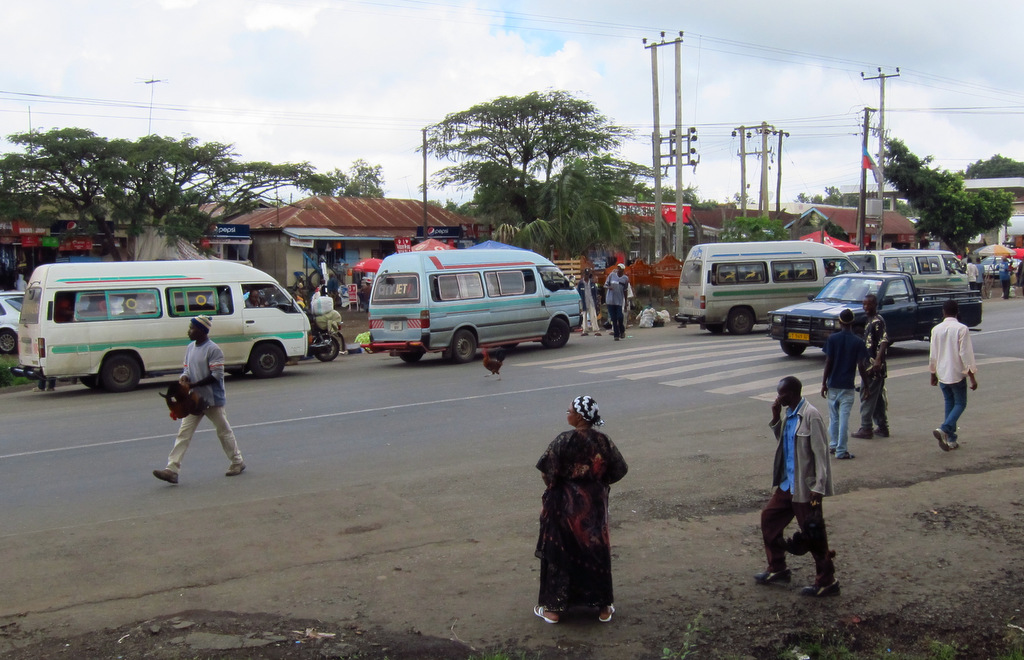
Please allow me to introduce you to the dala dala, the main mode of local transport in Tanzania.  At first glance it is a seemingly innocent looking mini-van with seats for fifteen that is usually packed beyond clown-car capacity making it a human sardine tin.  The most I have personally been involved in was 28, as much as I could see.  There is the driver up front and the conductor at the sliding door, who is usually a young man hired by the driver to get the van as full as possible in the shortest amount of time.  I have seen them physically drag a man resting under a shade tree on the side of the road into the vehicle while convincing him he wants to go wherever we are headed.  And somehow he obliges them.

The conductor is at least lucky enough to able to keep half out of the dala dala for  fresh air.
The guy in the back is one finger short of the peace sign.
There appear to be little if any safety standards imposed on dala dalas aside from the seemingly random regulation that they must have a fire extinguisher present somewhere inside.  If it works or has any juice left is a different story.  The drivers will literally drive these things until the tires fall off as I witnessed while waiting for one when the last bolt on a right-rear tire decided it couldn't hold on any longer and gave the passengers an abrupt jolt as it let loose and sent the tire down the road continuing its journey while the van came to a slow stop with sparks shooting from the axle.  Hence the fire extinguisher doesn't seem so random at this point.

Once inside, the seats and interior are arranged however the driver thinks will produce the highest occupancy.  This means that there are lots of sharp metal edges from modifications both new and old the least of which can slice clean through a vein or at worst impale you.  If you are lucky enough to get a seat, however unlucky enough to be a tall foreigner, your knees will spend most of the time in the volume of the back of the seat in front of you.  Sometimes they may actually go through.

It is important to hold your ground while the dala dala is being loaded and keep space for a pocket of air to breathe.  Hopefully it is not near someone's face, underarm, crotch, or rear but don't hold your breath because chances of this happening are rare.  On second thought, holding your breath until you pass out is a completely viable option and may make the entire experience less painful.  Once everyone is packed in, the conductor also presses in, slides the door shut if able and gives a click on the roof to tell the driver we are ready to proceed down the bumpy road ahead to our  next stop.  This doubles as good preparation in the event you are trapped in a collapsed building on a boat in rough seas.

More often than not the person who needs out first is the farthest in the back which means everyone has to get out and then re-jostle for position when getting back in.  The conductor usually waits to collect fares until the mess of human origami cannot move any more.  I think they do this for their own amusement.  Of course my wallet is in my back pocket.

Heading out to Msafiri's village, we had a total of eight going and one car that could fit five, with actual seats.  I drew the short straw and was left to take the dala dala.

Everyone's obviously excited in anticipation for the ride and we aren't even half-full yet.
I snagged a seat in the back.  I only hit my head on the roof 17 times.
Dala dalas seem to only travel on one road, back and forth, all day.  If you need to turn, you must get out of the dala dala you are currently in and wait at the intersection for one heading in your new direction.  So the more turns you need, the longer it takes.  We, fortunately, had only one turn and it was at a junction with an extremely busy market.  It appeared everyone was out to prepare for an Easter feast.

After we bought our vegetables, we headed across the street to pick up a couple of chickens.  Since power is sparse to non-existent in the rural areas, everything is sold live and butchered when needed.  The chickens are brought to the market in baskets on the backs of motorcycles, in boxes on peoples heads, or stuffed inside jacket pockets.  Their legs are tied together usually in series with other chickens making for a very uncoordinated chain gang.  One wily rooster somehow escaped temporarily from his 'shackles' and it took a group of about ten grown men and a few times across the highway before they cornered him and got him back in line.

An ideal place to use the 'Chicken Farmer' pick-up line on the correct lady.
For those who don't know it, my cousin would be disappointed if I didn't share:
-  Are your parents chicken farmers?
- No or Yes.  Why?
-  Because they sure taught you how to raise a cock.
I could insert another bad joke about a chicken crossing the road but will refrain.
In the end, they weren't willing to bargain on the two chickens we wanted, most likely because we were mazungu (the Swahili word for white-skinned people).  Msafiri said not to worry.  He had a friend in his village who would sell us a goat for cheap.

We loaded back into a new dala dala and went as far as the road would take us.  It had been raining the night before and the vans couldn't proceed any farther.  Thus we now hopped on the back of a boda boda or piki piki which is a motorcycle taxi.  We had to wait a few minutes until enough drivers and bikes could be rounded up to take the three of us.  My driver was the last to show up and appeared to be the most drunk or high or a combination of the two out of the drivers, which made for an adventurous ride over slick muddy roads, through herds of goats, and across flooded streams.  To make it more exciting, I decided to film with one hand for insurance purposes in the likely event of an accident and held on with the other:


Majimoto
Some groups of Masai have settled more than others.  Majimoto is like a large neighborhood with plenty of space between each house for the family farm.  There are permanent houses made of concrete but still very primitive.  It was easy to spot Msafiri's house since his brightly hued paint scheme stands out among the other drab colored houses but the inside is like most houses there.  They have a main front room for guests then four smaller rooms down a narrow hall.  One for storing goods and the other three are bedrooms for him, his wife, and three children.  There is no electricity nor running water but everything is kept clean, even the dirt outside is swept.  The one drawback is the outhouse.  It is around the side of the house and I was told it is occupied by very large cockroaches after sunset.  Luckily I never had to verify their existence.

More important than greeting the elders when you arrive is bringing candy for the kids.
Life is simple and most things you need are right around you.  The fence to protect the goats and cows at night from hyenas is assembled from thorn tree branches.  Cooking is done by digging a hole in the ground for a fire and setting the pot on top.  Hot pads are quickly plucked large tree leaves when needed.  Kids fill an old sock with small rocks and old seed to make a ball.  And if someone slips in the mud on the way to church in the morning, you just walk to the nearest puddle of water and clean off.  This may have happened to me.

Msafiri's daughter, their two cows, and pen for their goats.
Once settled in and unpacked, we had a bite to eat and then headed off for a tour of the village with Msafiri.  He showed us his brother's place who is a veterinarian and working on breeding a certain line of goat that produce chocolate milk.  (The chocolate milk part is a complete falsity but maybe someday dreams will come true.)  After his brother's place, we went to his other brother's place, his father's place, his cousin's place, his other cousin's place, and one more cousin's place before ending up at the local pub.

The local watering hole.  No line, dress code, or cover charge.
There were already a few gentlemen drinking on this Holy Saturday afternoon so we decided to join them for some warm beers.  I ended up sitting by the eldest of the group and somehow we hit it off even though my Swahili only got us to "How many daughters do you have and what are their ages?" and his English got us to "Hello".

He turned out to be the pastor of the local Catholic church and invited us to his mass on Easter Sunday.  I asked him if he always drinks on Saturdays before mass and he said just one packet of K-tan.
[Side Note:  The local drink of Tanzanians, aside form beer, is Konyagi which is a really bad gin.  K-tan is the off-brand Konyagi if that tells you anything.  They are both served in bottles or for those on a smaller budget, in clear packets similar to a large ketchup sachet.]
After he told me had just one, I asked him about the three empty packets on the ground by his feet.  This caused everyone to laugh out loud for the next five minutes and give the pastor much ribbing.  Once we settled back down, he told me he wanted to come to America, emphasizing just for a visit, not to stay.  I told him if he bought an airline ticket I would be more than happy to host.  He didn't quite understand how much it cost in US dollars so we converted it to goats and told him it would be about 16 goats to which he responded that he could have that many for me in 3 weeks.  Still waiting.

The pastor locked onto my arm after one to many.
Anticipating the taste of warm beer.
While we were there, Msafiri had called his friend with the goat to sell.  They brought it to the pub, of course by motorbike, so we could have a look at it and approve our transaction.  The goat seemed to be enjoying the field trip unbeknownst to him it would be his last.


It looked like a swell goat to us, so the gentleman drove the goat to Msafiri's house where we found it tied to the tree enjoying the shade without a care in the world.

For those who have never butchered a live animal, this maybe a bit much so close your eyes.  We gently lead the goat to the back of the house before grabbing it by its legs and flipping it on its back.  At this point it figured something was wrong and struggled quite vigorously.  Msafiri took his long Masai knife from the sheath on his hip, held the goats head still, and quickly slit the goat's throat.  It didn't take long for the goat to pass and as soon as he did the men deftly skinned him out and not a part was wasted.

From alive to skinned and butchered in less than 15 minutes.
Now you think you are a really funny guy when they ask you what your favorite part of the goat is and you say "The face." and they in turn reply quite seriously "Ok."  Before I could express that this was a joke, I was handed the goat's head and told to go start cooking it on the fire.  The kids could see I had not the slightest idea of what to do next since I was just standing there staring at the goat while it stared back at me.  They took me over to the fire and broke off a couple of sturdy branches that we shoved up the goats nose to use as handles.  The process was to place the head over the fire to burn the hairs, scrape them off with a knife, and repeat until most of the hair was gone.

This picture would seem pretty normal except for the fact that I am holding a goat's head on the end of a stick.
After I had perfected this process and was covered in burnt goat hair, Msafiri came and split the head with his knife and tossed it in the pot to boil.  While we waited, nothing draws a crowd in a Masai village like the smell of a goat roasting over an open flame.  Friends and family started filling in with drinks in hand until we numbered around 20.  As soon as something was ready, it was taken off the fire and passed around so everyone could have a taste.  The menu included kidney, liver, intestine soup, cooked blood, and of course the face.  As soon as the head was ready Msafiri passed it to me to do the honors but again I was a bit unsure of where to start when eating a face.  With the help of a few others we dug in quite well and I ended up eating some of the cheek and an ear.  Wasn't too bad but think next time I will say the shank which was delicious.

Eating order is adults, children, dogs.  That is for who gets to eat not who is eaten.
Once the goat was finished, the drinks began to flow a bit more liberally.  The clouds moved in as the sun set and turned the night completely black.  Msafiri began to lead the men in their traditional songs.  They are sung in a low throaty style with high pitched yelps thrown in.  Each person plays a different sound as they take turns jumping in the middle of the human ring while everyone around them dances a calm, stuttered bobbing of the head and body.  The women join in as well and have us all on our feet dancing with them.  Being out in a Masai village, dancing on the damp earth, listening to centuries old tribal songs while barely being able to see the person next to you was quite surreal.  After at least an hour of celebration, the skies opened up and the rain began to pour down.  We headed for the porch while the others scattered to their own homes.  The noise on the tin roof was deafening and the lightening brilliantly lit up the surrounding countryside for just mere glimpses at a time.  I have never seen it rain so hard for so long.  Eventually we all settled in on the concrete floor in the living room while the rain on the roof became a background noise as we drifted to sleep.

Surprisingly, in the morning everything was still there.  The cows and goats looked like they had had a rough night but they survived.  We had a quick breakfast, washed up in the rain water that filled all the buckets to the brim, and began our walk to church.  On the way, we ran into Msafiri's brother, the vet, who was elbow deep in a cow's vagina trying to help a calf out that was wrapped on the umbilical cord.  After a few minutes, the calf was out albeit a bit exhausted as well as the mother but both were healthy. His brother washed off his arm in a puddle (not the same one I used), rolled back down the sleeve of his button-up shirt, and walked with us to the church.  Just your standard Sunday morning.

Although Masai have their own traditional religion, many of them have folded it into Christianity.  The women showed up in shiny brightly colored dresses while most of the men have button down shirts and slacks.  They all seemed to have managed the slippery mud better than me.  Msafiri's wife sang in the choir and his daughter sang and played the drum.  The choir's enthusiasm and singing put most choirs I've heard to shame.

Waiting for the crowd to fill in and mass to start.  The children use the free time to stare at the mazungu.
After mass, we were snagged by my friend, the pastor, for one more quick chat before saying goodbye.  We had lunch and headed back to Moshi.  This time I got a seat in the car and for a ride that took 4 hours getting there by public transport, it only took 1.5 to get back.

Once back home I am sure we all thoroughly enjoyed our Easter weekend but also appreciated the shower and comfortable beds we slept in that night.  I had to shave my beard to get the goat out.

Hope everyone is well.
Cheers,
Jb

Monday, April 1, 2013

Peace in the Middle East - Dubai and Lebanon

My next destination was to the middle of the Middle East, Dubai.  One of my best friend’s from university, Gus, had moved there a few years back to be closer to his family in Lebanon.  A few other college buddies and I decided it was a good time to meet up there.

I had wanted to keep my journey on the ground or sea as much as possible and had contemplated crossing the Sahara Desert in a camel caravan or something to that effect, at least in my head.  However, the realities of the situation were much different and somewhat of a hindrance to my vague plans.  The Moroccan border with Algeria had been closed for years due to a rift between the two countries over oil rights.  Libya was blowing itself up from the inside and Egypt was stoning people in Tahrir Square.  To save my parents some grief and myself a sore ass from the camel ride, I decided to take the more traditional route and fly, but that doesn't mean there was nothing to write about.

Qatar Air was the cheapest option out of Casablanca and when I purchased my ticket on their website I was given a list of options for my name prefix such as Mr., Mrs., Miss, Doctor, Captain, Priest, Rabbi, Infidel, etc.… Well ‘Captain’ had a nice ring to it and since I had just recently sailed across an ocean, I felt like the title suited me quite well.  Plus, there were no questions asking to verify my identity so what could it hurt.

My plane was severely delayed leaving Casablanca.  After a few hours of reading all the leftover newspapers others had left behind while boarding their planes and being on a first name basis with all the saleswomen in the duty free liquor store, I finally asked an agent what the exact problem was and when we might actually leave.  She said, rather casually, they were still looking for a pilot.  At first I was quite disconcerted and normally would have had a few follow up questions like, "Well have you checked the pilot schedule I assume most airlines have?" or "Have you tried his cellphone?  It was invented in the 1980's and most, if not all people, carry one on their person in modern times."  However on this occasion before being asked who I was, or who my ticket said I was, I made haste back to the friendly women of the whiskey aisle. 

Finally onboard, our first of three legs was a short two-hour flight to Tunisia to pick up a few more passengers and I am guessing to also test the flight skills of whatever pilot they quickly recruited.  After a safe landing, while waiting for the new passengers to board, I wanted to check with a flight attendant if I would still be able to make my next connection in Doha.  She asked to see my ticket and the conversation went on like this:

Flight Attendant:  (After looking at my ticket.)  Oh, so you’re the Captain!  We knew we had a captain on board but weren’t sure where he was sitting. 
Me:  (After a slight stutter.)  Why yes, that is me.  You found him. 
FA:  Whom do you fly for?
(Now this is where tough decisions must be made and you have to commit to the role or bail out.  I committed.)
Me:  Well I am between airlines right now.  Looking for a change.
FA:  Well you should fly for us.  How many hours do you have?
Me:  That’s a very good question.  How many do I need?
FA:  You have to have 200 to apply to be a pilot with us.
Me:  Oh, I am just shy of 200.
FA:  Well get some more hours and send in your application.  This is a great airline to work for.
Me:  So I have heard.  Ok, I’ll look into it when I get the hours.  (Now to change the subject.)  So will I make my connection?
FA:  Oh yeah, let me check and I will get back to you after theses passengers finish boarding and we are set for takeoff.

(When everyone had boarded the stewardess came back and knelt beside my seat.)

FA:  Captain Berger, I'm sorry but we won’t make it in time for your original connection but there is a flight leaving one hour later you can catch.  Would you like me to set you up on that one?
Me:  Yes please.
FA:  Also, we have a few seats open in First Class if you would like to sit up there.
Me:  Hmmm, sure.  Why not.  It’s so stuffy back here with all these common folk.  Also can you get me into First Class on my connection out of Doha?
FA:  Sure.  No problem.

Before I even had my seat belt on in my new First Class seat, my first glass of champagne appeared and I was promptly asked what type of wine I would like to accompany my steak for dinner.  After I had the flight attendant explain the pros and cons of the two red wines on board, I told her to just bring me one before the meal and one during. That way I wouldn’t have to make another tough decision. 

Moral of the story:  If we ever meet in an airport, please refer to me as ‘Captain’ because that is what will be on my ticket from now on.

Dubai
A small family that struck oil and became rich beyond their wildest dreams and moved to the big city sounds like a good idea for a sitcom in the 60’s.  Instead of moving to the big city, the Emirates built the big city where they lived, in the desert.  Let’s call this show “The Desert Hillbillies”.  The Emirates transformed this sand swept region into one of the financial centers of the world and a tourist mecca of their own to rival their neighbor’s in Saudi Arabia.  Using the motto, “If you build it, they will come,” from one of their favorite Kevin Costner movies, ‘Field of Dreams’ (Luckily they haven't seen "Waterworld" or Kevin may have dropped a few spots.), they built one of the most grandiose cities in one of the world’s most barren places attracting visitors from all over the world to see their man-made marvels.  Using cheap labor from Ethiopia and the Philippines along with shrewd business sense, they turned Dubai into a regional powerhouse in less than a decade.  

The Burj Khalifa
~ The city currently boasts the world’s tallest building, the Burj Khalifa, standing at 2,722 ft (829.8 m) tall.  This trumps the previous record holder by an astounding 700 ft (200 m).

~ It’s home to the largest mall in the world, which out-built the old record holder that was also in Dubai.  The current record holder has a Red Lobster.  The previous record holder has an indoor ski slope where you can meet and greet penguins.

~ They have the world’s only 7 star hotel, the Burj Al Arab, which has a helipad that doubles as the world’s highest tennis court.

~ And since every rich person’s dream is to have their own island and there were none in the vicinity of the Persian Gulf, the Emirates again built their own and of course not just any island.  Known as Palm Jumeirah, it was built in the shape of a palm tree, it is the largest artificial archipelago in the world .  It is home to 60 luxury hotels, 4,000 residential villas, 1,000 water homes, 5,000 shoreline apartments, and multiple marinas, restaurants, and shopping malls to satisfy the masses.  Two more palm islands are underway and an island map of the world consisting of 300 smaller islands all of which can be owned.  I put a down payment on Fiji.  Thought it would be cool to say I owned Fiji even if it is the one off the coast of Dubai.  

The Burj al Arab
Tennis court / Helipad


(I couldn't afford stepping foot in this hotel much less renting the helicopter for these photos.
Image compliments to Google.)

Aquarium in Dubai Mall:  Another world record for largest acrylic panel.
World record as the only seafood restaurant to offer endless snow crab legs in 2003 
almost causing the franchise to go bankrupt.  It's true.  Look it up.  
Cooling costs for a ski slope in the desert:
Sky high  
Ski outfits leftover from the Dream Team:
Dirt cheap
This was as close as they allowed Frank
to the actual penguins.
 The Palm Jumeirah:  Required 65 million pounds of sand and rock.  
(Again image compliments to Google.)
A view of the skyline shows nothing but skyscrapers and cranes building more skyscrapers pushing farther and farther out into the open expanse of desert with nothing to stop it.  It is a city built on opulence and decadence where you wouldn’t question if the streets were paved of gold.  

If it’s not obvious by now, Dubai is a place meant for spending money and for a guy traveling with just a pair of flip-flops and a few swimming trunks, this wouldn’t be my first choice for travel destinations but I had friends to meet.  And usually when I meet with these friends, we tend to do more drinking and partying than sightseeing.  Good thing for us the main attractions in Dubai are drinking and partying.

Although Islam is the state religion, things are kept pretty relaxed to keep the international clientele coming in especially compared to its neighbors:  Saudi Arabia, Oman, and Iran, and thank Allah for that.  The one exception are the "sex police".  No, these guys don't barge into your room at inappropriate times to critique your bedroom swagger but they do lurk in the corners of most bars and night clubs to make sure no "inappropriate" behavior takes place.  This would include any public displays of affection, dancing too provocatively, or in Frank's case, dancing by yourself on your back in a seizure type fit on the dance floor.  Luckily they weren't sure what to do with Frank and he was just given a stern warning after first checking if he needed medical attention.... multiple times.  However things can get quite serious and the jails are filled with Brits who had a night on the piss and if at home would have just been laughed at by their friends for pulling their pants down, but here they are thrown in jail and deported. 

Frank using a choke hold on me and himself to get us "dancing".
And no, I don't know what I was drinking.  It was very, very late.

Lebanon
For all of Dubai’s newfound glitz and glam, Lebanon still holds sway over most Europeans and Middle Easterners as the vacation capital of the region where the attention is focused in and around Beirut.  The city is one of the most cosmopolitan and religiously diverse cities in all the Middle East holding onto a complex network of nine major religions:  Maronite Catholic, Greek Orthodox, Greek Catholic, Armenian Apostolic, Armenian Catholic, Protestant, Sunni Muslim, Shia Muslim, and Druze.  However, just because they are all living together in the same city doesn’t mean they have always gotten along.

Lebanon had a brutal civil war beginning in the 1970’s and lasting until the early 1990’s mostly between the Christian and Muslim majorities leaving scars that are still visible today including a tattered power infrastructure causing ill-scheduled blackouts all day and night.  Even though Beirut has cooled over the years, their neighbors to the north and south still keep things lively.  Syrian rebels use the north as a retreat and safe haven from the Syrian army who unpredictably lob bombs across the border in retaliation for harboring the rebels.  To the south lies Israel/Palestine where Hezbollah forces amass to defend their land from the Israelis since the Lebanese army is little to non-existent.

If Lebanon's current political situation is intriguing, its ancient history and natural landscape go far beyond that.  It is home to Byblos, the oldest inhabited city in the world just north of Beirut dating back to 8800 B.C.  The country's coast line is littered with remains from Phoenician, Hellenistic, Roman, Byzantine, Arab, Crusader and Ottoman civilizations.  The interior is filled with magnificent cedar forests which are the symbol of the country and a cave system that is on the short-list as a new wonder of the world.

Of course Gus wanted us to see as many of these sites as possible.  He also wanted to take us to the best night clubs and beach bars which ended in some very late nights getting home.  This sometimes made for difficult mornings lacking the motivation to get up and see a very old building that will most likely be there for years to come while still seeing double and wondering why my shirt is on inside out and the shoes I have on aren't mine and don't match.

Once we got going, the sites were incredible but getting there and back was usually half the fun since Gus's sense of direction is on par with an Asian woman who has blonde hair.  Getting lost and asking locals for directions is never a big deal, however making a wrong turn or bad exit and ending up in Hezbollah territory can lead to some site-seeing that none of us were too keen on seeing.  We were actually told by many people that it would be quite safe and interesting to have someone drive us through for a tour of a Hezbollah neighborhood but we could never find anyone to volunteer.... intentionally.

Driving around the country is one thing but driving in Beirut is another.  It has the worst traffic I have ever seen or could fathom.  On an 8-lane road, with 4-lanes for each direction, traffic starts to build up a few miles before an intersection coming into town.  The cars going one direction, the direction we are headed, are completely stopped so the people start using the other 4 lanes heading the wrong way to bypass the traffic.  Soon all 8 lanes are jammed with cars trying to go one direction while coming from the intersection 8 lanes are jammed coming the other way with no room to pass.  It seems infuriating and mind-boggling that this can actually happen and it can take 2 hours to go 2 miles but yes it does.  After having some time while sitting in the aforementioned traffic to reflect upon how people can drive like this, I came to the conclusion that after living through years of civil war and complete devastation, driving the wrong way down a street really isn’t that big a deal.  You could always handle it like these guys who kept the traffic and themselves entertained for most of the time:


But this tends to be the attitude of the people.  To make the best out of whatever situation they are in.  To enjoy yourself when you can because tomorrow things may change.  It is a country of contrast with a five-star hotel built next to a blown out building, a luxurious home rebuilt next to a neighbor’s still pock-marked with bullet holes, a Vegas style pool bar next to a mosque, a concert venue hosting the most current performers in one of the oldest cities in the world, bombs dropping in the north while tourists party on the beach in the south.  It is a country of resilience and great pride trying to lead the way as the multi-cultural example of the Middle East.

View from Byblos looking south to the beach clubs and coastal neighborhoods.
A day at the beach turns into an evening for dinner on the coast
A model posted on a wrecked building winks at drivers as they sit in Beirut traffic. 
The Lebanese flag during sunset on the Mediterranean Sea.
All in all we somehow managed to see most of the sites as well as make the most of our nights.  If I remember correctly, and I probably don’t, I think we were only kicked out of 2 places (Once for flirting with Disaster, the club owner’s wife, and once for starting and being the only participants in a ‘Dance-Off, Pants-Off’ contest.  Luckily we weren’t in Dubai.)  And that ain’t bad for a bunch of guys named Bay Jerger, Mother Goose, O-train, and Dirty Frank.


Cheers,
Jb

Saturday, March 16, 2013

Rock the Casbah - Morocco


Preface:  A couple of paragraphs may require a rating of PG-13 so for any parents who let their kids read this, God help you.  If you are reading this at work, please read it out loud.  Also, I have uploaded many more photos for Morocco at the link on the right.

It's amazing how two points of land separated by a sliver of water can be worlds apart, yet this is what happens while on the ferry crossing the Straight of Gibraltar.  To the north lies Spain where, aside from speaking Spanish with a severe lisp and bulls occasionally chasing you through the streets, most things seem normal to the Western eye.  To the south lies Tangier, Morocco's northern most city and the gateway to North Africa where the cities are composed of labyrinth like medinas filled with artisans, tribesmen, shopkeepers, and lost tourists all surrounded by the grand Atlas Mountains which are in turn  surrounded by the vast Sahara Desert.  These are my favorite places, where civilizations collide, and I was looking forward to getting off the ferry and stepping foot on the African continent.

Below is the route I traveled through Morocco, starting as mentioned in the northern most city of Tangier, then headed south to Fes, then to the desert outside of Merzouga, then through Marrakesh before ending up in Casablanca.
Journey through Morocco:  Tangiers, Fes, Merzouga, Marrakesh, and Casablanca.
Tangiers is undoubtedly the most touristy city in Morocco due to its proximity and ease of access to Europe allowing many day trippers to take the short ferry ride across the Straight and be back before sunset.  Tangier is a beautiful seaside town with camels lazing on the beach hoping no one wants to go for a ride while women covered in head-to-toe black burkas go swimming in the ocean and once submerged immediately turn into something resembling a huge black jellyfish.  The white-washed walls of the city rise from the beach protecting the homes and medina inside and extend upwards to the old casbah or fort that safeguarded the city in days gone by but still stands as one its main attractions.

Morning view from my hotel roof top as the sun begins to bathe the city.
Tourists consider if they want a ride and camels consider if they want to give one.
Locals enjoy the evening view from the battlements left in place on the casbah with Spain in the distance.
Being that there are many tourists means that there are equally as many touts trying to sell you anything you could possibly imagine and many things you don't want to imagine.  Most of the time you almost expect them to pay you for taking this crap off their hands.  As a 35 year old male, I am just not in the market for a pinwheel that lights up or a spinning top that makes a very annoying noise no matter how many times you shove it in front of my face.  On the other hand, my cousin's child has a birthday coming up.  I'll take the annoying noise making spinning top.  Do you gift wrap and ship?

To say the least, eyeing up their customers is not their specialty.  They go for quantity not quality.  However there was one gentleman who must have taken a 2 week online business course because either he could tell by my posture and jaw line that I was a sucker for subtle humor or because I was the only obvious foreigner gathered in a crowd to watch a local children's acrobat performance.  He approached quickly with a monkey in tow and got right to the point, "My monkey likes penis."  Well I appreciate the valuable insight and will make sure to avoid you in the future but monkeys aren't really my thing.  I am more into quality than quantity my friend.  "You pay for penis."  At this point I was unsure of whose penis we were now talking about but was still pretty adamant about not paying for any type of transaction involving this man and his monkey.  Being unsatisfied with my unyielding answer of "No, please go away.  We are at a children's performance and this seems quite inappropriate", he then stuck his hand in his pants.  I thought if this was happening back home I am pretty sure myself, this man, and Bobo Jenkins the monkey would end up sharing a small cell but luckily here, the nearest police were bickering over which way was up on a fallen stop sign.  Luckily also when the man pulled his hand out of his pants he had a handful of peanuts.  A big smile appeared on my face which my friend assumed was just because I was happy to see peanuts but also because, due to my esteemed colleague's accent probably since he was taught English by the British, I now understood that he pronounced peanuts like penis.  Well in that case, how many can I buy.  I'll even help you find more tourists as long as you keep the peanuts hidden and say 'penis' to them until they are about to hit you.  Let's go.

These are the young acrobats.  I thought it better not to show a photo of the tout, his monkey, and the 'penis'.
Shark:  the other white meat.
Tangiers is a great introduction to Morocco.  The medina is just large enough not to get too lost in and it is always easy to find your way since the sea is right beside you as your guide.  Also, the Moroccan seafood is fantastic.  One evening I made my way to a recommended local spot that is somewhat hidden but well known for its seafood.  There wasn't really a menu.  You were just told to sit down and a 5 course meal started showing up consisting of  whatever they had caught and prepared that day which at least meant it was fresh.  Everything from the seafood soup, to the spicy shark, to the whole fish kebabs, to the strawberries and almonds covered in honey for dessert was delicious.  After eating most of the seafood that was available in town I decided it was a good time to head out and take the 6 hour train ride south to Fez.

Fez is one of the oldest trading cities in the world and its medina is world renown packed with homes, hotels, shops, restaurants, butchers, tanneries, bath houses, and everything else that is needed to make a city tick.  New comers who want to explore the shops, or souks, become lost after just a few turns as there are no signs and small corridors lead to large passage-ways to small single-file alleys to old wooden doors to main thoroughfares.  Touts are posted up like vultures to immediately prey on those who are obviously lost and charge them a small fee to lead them out but the entire point of going to Fez is to get lost in the medina and as long as you keep heading in one direction you will come out somewhere.  
Just a portion of the vast medina that is Fez.
My luxurious riad and enthusiastic bellboy.
As usual, I adhered to my strict practice of waiting to think about accommodations until I am enroute to my next destination.  I met a fellow on the train who assured me of the most luxurious accommodations at his friend's new hotel in Fez for a fair price.  After the 'fair price' was negotiated and my train arrived in Fez, I was led through a maze of alleyways before surprisingly ending up at an extremely nice riad, or hotel.  The manager wasn't too happy with the price his friend agreed upon and I wasn't too happy with trying to remember where my hotel was located but after a couple days I had my route to the hotel down and figured the best way to explain it is by video.  After watching this myself it is apparent I am not cut out for making documentaries and will stick to photography but it gets the point across none the less:


Getting up the next morning and seeing my 'friend' from the train in the lobby I knew there was more to it than helping me find nice accommodations.  He told me he was going to buy some carpets to send to his other home in Switzerland and I could come along if I wanted to at least have breakfast there.  Sure breakfast at a carpet shop sounds fantastic.  Of course I knew what I was getting into but I did want to see a carpet shop since they are supposedly some of the best in the world plus it would be entertaining to see how good these guys are.

On the way through the medina to the shop, my 'friend' is telling me that the annual art expo just finished up and now all the artisens, including carpet makers, are selling everything that didn't sell at extremely cheap prices.  That is why he is here and I should feel lucky.  Lucky indeed.  I sent out a Tweet as soon as I could.  We walked into the carpet shop and before my eyes could adjust from the bright sun to the shaded interior I was lead to a comfortable side room where a full breakfast was laid out and told to just relax and enjoy the food.  After breakfast, the pleasantries were over, the gloves came off, and it was time for business.  Here is the cliff note version of how things went:
-----------------------------------------------------
Salesman:  Which one do you like?
Me:  Well they are all very beautiful and it is difficult to decide.
SM:  That is ok you can buy many.
Me:  Actually I don't want to buy any.  I just wanted to have a look.
SM:  Which color do you like?
Me:  I guess the blue-green is really nice.
-The salesman claps his hands and barks a few commands at 4 old seemingly crippled men who painstakingly unroll 6 more rugs in front of me.-  
SM:  Which one of these do you like?
Me:  They are all nice but I am really not going to buy any.  And I understand you are using these old men to make me feel sorry for them so please stop asking them to unroll your entire inventory of carpets for me.
SM:  Ok, well just take off your shoes and walk on this.  They are double sided.  This side is for the summer and this side is for the winter.  
Me:  Well I am from Texas and we don't really have winter.  Do you have a side for really hot and really humid?
SM:  Look at the stitching on this one.  Three women went blind while making it.  If you buy it you will support them and their families for 6 months.
Me:  That is unfortunate.  Can I just donate some money to them.  I can't fit a 12 ft x 6 ft rug in backpack.
SM:  That is no problem we can ship it very cheaply.
Me:  More importantly I just do not want to buy one and have no need for it.
SM:  So you can't use it.
Me:  Exactly.  Hence I don't want one.
SM:  Well perfect.  You can sell it when you get back to America and pay for your trip with the profit.  Look at this book signed by previous customers.  Daren and Kate from Australia wrote, "We bought 8 carpets and sold them when we got back home.  It paid for our entire trip and we also had enough extra money to pay off our student loans, buy the Outback Steakhouse franchise, start a koala/kangaroo breeding foundation (how cute would their babies be), fund a new Australian Space Agency, buy our own airplane to fly back, buy more carpets, and sign this book to tell everyone about this amazing deal.”
----------------------------------------------------

I will say being able to start my own space agency and breed kangoalas was intriguing but I had had enough and was ready to leave.  Plus after refusing to buy a carpet so many times, I got kicked out and never saw my 'friend' again. 

Elbow-to-elbow traffic in the Fez medina.
After getting kicked out, I was left to roam the crowded medina on my own and in no time had another tout at my hip.  This one wanted to show me a leather shop/tannery.  Sure why not.  It's still the morning and I was hoping to get kicked out of three shops by midday.

Once inside the shop, I was handed over to the proprietor who seemed more perturbed that I interrupted  his black and white soap opera re-run of 'Esek, the Donkey that Always Sleeps' than interested in making a sale.  He haphazardly lead me through four stories of hand crafted leather goods which were all actually very nice but out of walls and walls of women's brightly colored slippers, they didn't have any in my size and if I couldn't get the slippers, why would I buy a matching handbag.

After we finished the fourth floor he asked if I would like to see the terrace and before I could answer he handed me two small mint leaves and began leading the way.  As soon as we stepped foot on the terrace there was a foul odor in the air.  He looked back and could see the disapproving look on my face and the mint leaves still in my hand as I was unsure what they were for.  He motioned to roll them up and place them in my nose to help mask the stench.  I wished I would have had these when I was strolling through the meat market.

We walked to the edge of the roof top and below at ground level to my surprise was a vast open area of small pits filled with different colored water with some men running back and forth carefully between them.

The old-fashioned tanneries of Fez.

This was a sight I had seen before in travel magazines and on tv but never thought I would stumble upon it here in Fez.  These are the oldest tanneries in the world and they have been operating in the same way for centuries turning animal hide into workable leather using techniques founded during the medieval period.  I immediately had to get down there although once in the tannery it was quickly apparent that flip flops weren't ideal foot apparel for the ground level tour with buckets of lye, vats of pigeon dung, and all states of animal hide spread about.  I gingerly made my way through.

The process:
They bring in stacks of animal pelt on the backs of donkeys through the narrow and packed alleyways of the medina.  Once unloaded, lye is applied to help remove any of the fur or hair left after shearing.  Then the hides are put in pits of water and pigeon dung where the workers stand waste deep and work on the hides like grape crushers at a vineyard to soften them up.  They are left to soak for a few days, then taken out and washed in a gigantic manual tumbler before being dyed and set out to dry.  It is quite an amazing process to behold and every chemical they use is natural from the lye to the pigeon dung to the dyes:  saffron for yellow, henna or madder root for red, indigo for blue, cutch from the acacia tree for brown.

Esek the donkey ready for his rest.
Applying lye with a smile.


Vats for dye.
The large wooden tumbler to wash the leather.
Yellow leather soaked in saffron set out to dry on the roof tops.

The final product - shoes to decorate your shop walls.

This was a live falcon.
Didn't ask what it cured.
After the rug shop and the tannery I was done with guides and spent the next couple days just getting lost and finding something interesting around every corner.  The local Berber pharmacies were always a favorite and interesting to walk into never knowing what you would find.  They had a plethora of different mostly dead animals to choose from and shelves of twisted twigs and roots soaking in some type of odorous fluid.  While doing a bit of online research on Fez I came across one man's comments on a pharmacy item:  "Don't eat the seed-pod like things the proprietor offers you. Although he's eating them also, they are very high in estrogen and can cause a man's nipples to be sore for several days afterwards."
(Note to self :  Next time at the pharmacy, find medicine for sore nipples.)


This is what they wanted me to wear.
I stuck with my own traditional garb.
Fez is remarkable but after so many days exploring the medina It gets a bit suffocating.  Luckily the Sahara Desert is just down the street.  I took a 12 hour bus ride over the Atlas Mountains to the ends of the earth in Merzouga for a camel trip into the desert.  It wasn’t really high season so I was the only participant in the camel caravan.  My guide walked in front of me sometimes talking on his cell phone but after 15 minutes we were past the first dune and surrounded by endless desert.  We rode about 2.5 hours to a site of Berber camps and a little oasis tucked below a mountainous sand dune.  It was definitely peaceful and relaxing sleeping in the open on a mat with just the stars overhead.  My guide told me next time I came I should come with him to where he is from.  It is only 5 days more by camel into the desert.  I told him that just after 2 hours on that camel my ass was pretty sore but I knew a monkey in Tangiers that might make a good travel companion.
A one-camel caravan.
My Berber guide pretending to sooth his camel.  They are one of the most ornery creatures I have ever met.
I guess I would be in a foul mood as well if I was the beast of choice to carry people
and their belongings through the desert.
Our camp for the night.  I slept in the middle on a very nice carpet with just the stars overhead.
After this I headed back into the thick of things to Marrakesh.  If Fez is the heart of Morocco then Marrakesh is its cultural capital.  Home to the busiest square in all of Africa, Jemaa el-Fnaa, which means 'Assembly of Trespassers'.  It is still filled every night as it has been for years with snake charmers, fortune tellers, Berber musicians, magicians, baboons, and all those that come to witness the spectacle.  The only thing that probably hasn't been here for centuries is the 'ring around the coke bottle' game:

Locals can't get enough of trying to put a ring around a bottle of coke.
Snake charmers aren't that charming.
Lights at night in Jemaa el-Fnaa Square.
What's for dinner - the entire sheep's head or just the brain?  Kids eat free.
Aside from Jemaa el-Fnaa, Marrakesh is filled with the grandest palaces, tombs, gardens, medinas, and people watching Morocco has to offer.  The main medina in Marrakesh isn't as lived in as the one in Fez and is set up more for tourist shopping resembling something akin to Aladdin's Cave when you enter.

There are plenty of restauranteurs vying for your appetite and money as you walk the streets especially around Jemaa el-Fnaa but it offers the best people watching.  One day during a lunch time stroll a friendly lad presented me with an overly adequate menu so I decided to have  a seat and watch the crowd meander by.  After taking some time to finally decide what I wanted from the exhaustive choices, I called the waiter over and pointed to my first pick.  The waiter then told me they were out of that.  I pointed to my second item.  That is not good.  I pointed to my third item.  We don't make that any more.  Ok, just tell me what I can get.  Kebab.  Ok give me that.  So the waiter went and pulled a few kebabs out of the warmer that were probably made yesterday and I gnawed at them for a while at least enjoying the parade of people passing by.  Luckily there was a cheap ice cream place just next door.  The ice cream was delicious but as a piece of advice make sure to have it finished before the sand storm roles in or it gets a bit gritty.

After my travels through Morocco with just one more short stop to go before leaving the country I decided to indulge myself and relax in a hamam or traditional bath house.  There are separate hamams for men and women of course and it's basically a sauna/bath/massage place where you can get bathed and massaged by a full grown man for a small fee.  Who could pass that up?  The description calls it a relaxing massage and bath but it seems more akin to some practices during the Salem witch trials with the amount of contortions they put you in and scrubbing they do.  I definitely admitted I was a witch more than once but that didn't seem to be enough to make it stop.  I will say that they thoroughly scrub every inch of whatever is exposed.  I had on my swimming trunks but the local attire seemed to be a just a pair of tighty whities. You might think it a bad idea to go into a hot bath house in a town that is situated in the desert however it is so hot inside that the 100 F degree temps outside seem relatively cool afterwards.

Once I was thoroughly satisfied with my time in Marrakesh, I left one day for Casablanca before I flew out.  For all it's fame and lore, there really isn't much to see in Casablanca even though it is Morocco's largest city and is home to the largest mosque in North Africa.  Even the famed Rick's Cafe was just recently built a few years ago to satisfy tourists.  Of course I went.   

Rick's Cafe - Best meal I had eaten in a long time accompanied with Casablanca Beer.
The inner courtyard of the massive Hassan II Mosque.
Third largest mosque in the world.  Tallest minarets in the world.
Capacity of 25,000 worshippers inside, 80,000 outside.
I know that was a long read and if you made it this far, thanks.
Hope everyone is doing well and always great to hear from everyone or anyone.
Only one more entry until I am caught up to my current location.  Five points for anyone who knows where I am now.

Cheers,
JB


Self-portrait:  Here's lookin' at me.
-----------------------------------------------------------------------------------
Unpaid Advertisement:
I have no idea what it tightens but he guaranteed results.
My buddy with the monkey from Tangier asked me to advertise some of his other products and in return he would give me a cut in any new sales.  So the next time you are in Tangier please stop in at his shop and make sure to mention my name;)